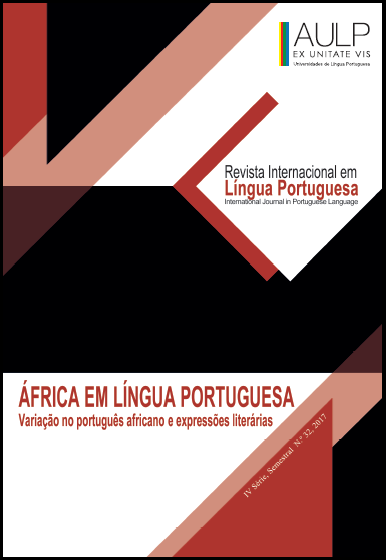
We live in a globalized world, full of innovations in all spheres of society, thus challenging interdisciplinarity in the academic-scientific space. In this volume the linguistic variation of the Portuguese (4 chapters) and the palopian literature (6 chapters) are discussed, which interact with a harmonious dialogue. Thus, it is observed that the Portuguese language spoken in Africa gradually distances itself from the European variety and presents its own linguistic characteristics at the phonetic-phonological, syntactic, semantic, lexical and pragmatic levels. The 'palopian' literature acquires more and more its own identity, giving rise to a genuinely African literature with its own characteristics. This trend is proven through several studies that will be represented here. The Portuguese Speaking African Countries (PALOP) is multilingual and multicultural. This multiculturalism has some influence on how Africans speak or (re) tell their realities. No African born and raised in that context can express itself as it is spoken in Portugal, which means that the PALOPs adopted Portuguese and make use of it according to local realities. The educational system has faced failure due to the copying of foreign teaching models and without rethinking the local reality. It can be seen that the educational situation in PALOP is complex and, therefore, some voices (such as we will read in this book) have focused on bilingual education as a possible measure to eliminate school drop-out, increase the self-esteem of students and communities where several native languages are spoken. In this sense, this work brings together works of researchers that fundamentally discuss issues internal and external to African languages; the situation of Portuguese in Africa and its variation; and also debates about literature and its meanings in the space of the PALOP under the analytical perspective of Africans and Brazilians.
Full Issue
Articles
APRESENTAÇÃO. Africa in Portuguese Language: Variation in African Portuguese and Literary Expressions
Abstract 1066 | PDF (Portuguese) Downloads 1676Page 11-16
The Linguistic Variation of Mozambican Portuguese: a Sociolinguistic Analysis of the Variety in Use
Abstract 36146 | PDF (Portuguese) Downloads 31477Page 19-38
Norm and Linguistic Variation: Implications in the Teaching of the Portuguese Language in Angola
Abstract 4397 | PDF (Portuguese) Downloads 5337Page 39-54
Expressions of Power and Solidarity in Mozambique and Angola: Observing the Interrelationship Between Gender and Forms of Treatment
Abstract 1069 | PDF (Portuguese) Downloads 1421Page 55-80
The Creativity of the Portuguese Language: Study of Mozambicanisms in Mozambican Portuguese
Abstract 2508 | PDF (Portuguese) Downloads 3839Page 81-97
The Teaching-learning Process of Portuguese in the Multicultural Mozambican Context
Abstract 3899 | PDF (Portuguese) Downloads 10939Page 99-120
Collective Memory and Construction of Linguistic Identity in the Narratives of Alfredo Troni and Uanhenga Xitu
Abstract 1068 | PDF (Portuguese) Downloads 1125Page 123-146
The Luso, the Tropic and the Tinny Dog in the Literary Revelations of Honwana
Abstract 1262 | PDF (Portuguese) Downloads 1050Page 147-162
The Senses and Non-senses of the Portuguese Language: Questions of Language and Language in the Short Stories of Mia Couto
Abstract 1204 | PDF (Portuguese) Downloads 1346Page 163-180
Mulher nos Contos de Mia Couto: uma Leitura Pós-colonial
Abstract 1198 | PDF (Portuguese) Downloads 1263Page 181-190
Conrad and Eça's Anticolonial Silence, or the Impossible Art of Narration of Horror
Abstract 836 | PDF (Portuguese) Downloads 619Page 191-206
The Use of LWC's in Mozambican Music
Abstract 1020 | PDF (Portuguese) Downloads 1049Page 207-225